How to Meal Plan for a Family With Different Diets
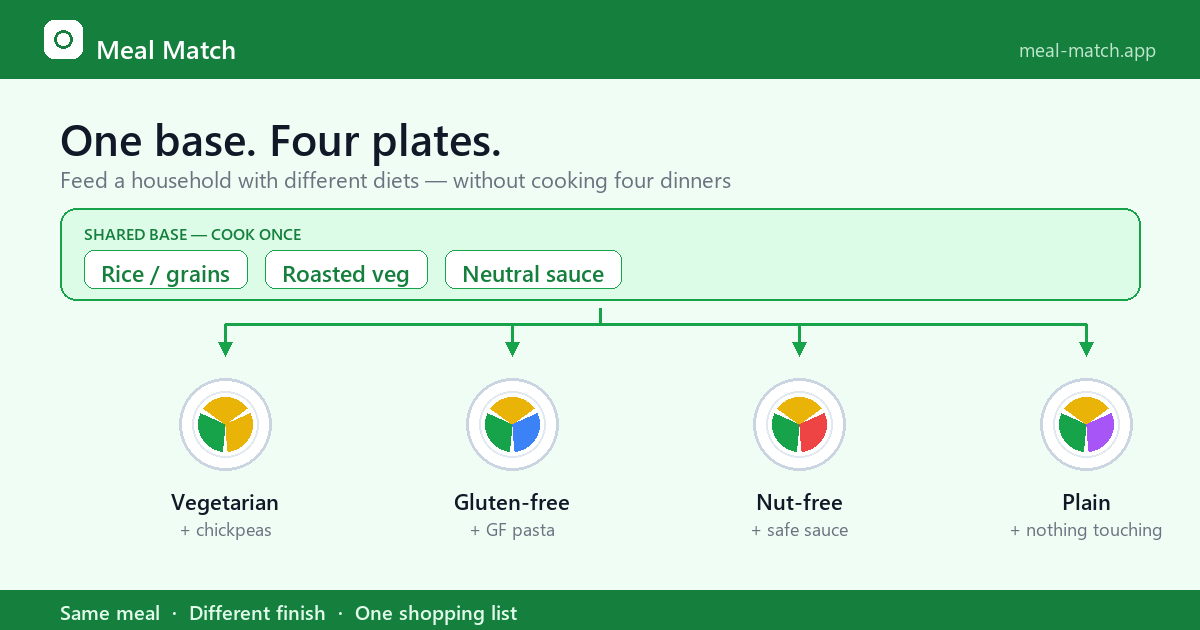
One person's gone vegetarian. Someone else can't have gluten. There's a nut allergy in the house. And the youngest has decided that food must not touch other food. Cooking for a household like that can feel like running a small restaurant with four menus and one pair of hands — so most people either cook several dinners a night or quietly give up and repeat the same three meals forever. There is a better way, and it isn't a compromise meal nobody enjoys. It's a change in how you build the plan.
The real problem isn't the cooking — it's the planning
Ask anyone feeding a mixed-diet household what's exhausting about it and they rarely say the cooking. They say the deciding. Every evening turns into a puzzle: what can we make that she can eat, he'll actually touch, and nobody has to have separately? That decision, made from scratch at half past five with everyone hungry, is the part that wears people down.
Cooking separate meals is the natural response, and it's the thing that makes it worse. Three dinners means three lots of pans, three lots of timing, three lots of washing up — and a shopping list assembled from several different heads that always seems to miss something. It's not sustainable, and it's not necessary.
The households that manage this well aren't better cooks. They've just stopped planning meals and started planning a base and its finishes.
1. Write down who genuinely needs what
Start with the least glamorous step, because it does more work than anything else: get everyone's requirements out of your head and onto one piece of paper. One line per person. Then sort every item into two columns, because they are not the same kind of thing at all:
- Non-negotiable — allergies, intolerances, coeliac disease, and anything advised by a doctor or dietitian. These are safety and health requirements. They don't bend, ever, and they get planned around first.
- Flexible — ethical and lifestyle choices, strong dislikes, and the long list of "won't eat that" that most families accumulate. These matter and deserve respect, but they can be worked around, swapped and negotiated.
Almost everyone who does this discovers the same thing: the list of genuinely hard rules is much shorter than it feels. A house that seemed to have five incompatible diets often turns out to have one real restriction, one ethical choice and three strong preferences. That's an entirely manageable problem — it just wasn't visible while it lived in your head as a vague sense of impossibility.
2. Find the overlap you already have
Next, write down every meal that everybody in the house already eats happily. Not meals you think they should eat — meals that actually go down without a negotiation.
People are usually surprised by how long this list is. Most households already share a core of ten or fifteen meals: a pasta dish, a rice dish, a roast, fajitas, jacket potatoes, a curry, a stir fry, soup and good bread. That shared set is your foundation. It's not the whole plan, but it means you're not starting from nothing every week — you're extending something that already works.
Put those meals in the rotation first. Fill the gaps afterwards.
3. Build each dinner as a shared base plus separate finishes
This is the method that changes everything, and it's the way commercial kitchens have always handled it. Instead of cooking one fixed dish that has to suit everybody, cook one base everyone can eat and finish each plate differently at the end.
In practice:
- Fajitas — peppers, onions and rice for everyone; chicken in one pan and spiced beans in another; cheese, soured cream and guacamole go on the table rather than in the dish.
- Pasta night — one tomato sauce with no meat in it, then a portion of gluten-free pasta alongside the regular, meat or lentils stirred through separate bowls, cheese optional at the table.
- Roasted vegetables and grains — one big tray, one pot of rice or couscous, then halloumi, roast chicken or chickpeas added per plate.
- Jacket potatoes or a curry — the base is naturally neutral and the toppings do all the work.
Two things make this so effective. First, the actual extra effort is small — a second small pan and a few bowls, not a second dinner. Second, and more importantly, everyone eats the same meal. There's no "special dinner" for one person, which matters enormously to children who are already conscious of being the one with the different plate.
It's also a quiet win with fussy eaters. When food arrives as components rather than an assembled dish, a child who "doesn't like" a meal can build a plate they'll accept from things they already eat — without you cooking anything extra, and without a negotiation.
4. Keep allergens genuinely separate
Everything above is about convenience. This part is about safety, and it works differently.
An allergy is not a preference and can't be handled with the same flexibility. Where a household includes a food allergy, the practical rules are:
- Make the allergen-free version the default wherever you reasonably can, so the safe meal is simply the normal meal and there's less to go wrong.
- Prepare it first, on clean surfaces, with clean utensils and clean pans, before the allergen is anywhere near the kitchen.
- Keep it physically separate — covered, on its own board, served with its own spoon. Cross-contamination is the risk that catches people out, not the recipe.
- Read every label, every time. Product recipes and manufacturing arrangements change without notice, and "it was fine last month" is not a check.
- Follow your specialist's advice on that specific allergy, including anything about "may contain" labelling and eating outside the home.
A meal plan makes allergy life easier because it removes last-minute improvising, which is when mistakes happen. It doesn't replace label-checking, and no app can do that part for you.
5. Batch the base, vary the finish
Once dinners are built as base plus finish, batch cooking suddenly gets much more useful — because the part worth cooking in bulk is the part everyone shares.
Cook a large tray of roasted vegetables, a big pot of grains, a neutral tomato sauce or a batch of plain roasted chicken, and store the components separately rather than as finished meals. Wednesday's dinner then becomes assembly rather than cooking: reheat the base, add tonight's finishes, done in ten minutes with four different plates coming off it.
Storing components separately is what makes this flexible. A finished mixed dish can only ever be that dish; a tub of roasted vegetables and a tub of rice can be four different dinners this week. Our guide to batch cooking for beginners covers the cooking and storage side in more detail.
6. Shop from one list, not four
Mixed-diet households leak money in a very specific way: several part-lists in several heads, duplicate buys, forgotten items, and an extra trip on Thursday because there's nothing the vegetarian can eat.
Build a single list from the week's plan instead of from each person. Shared base ingredients appear once, in the quantity the whole house needs. Individual finishes — the plant-based protein, the gluten-free pasta, the dairy-free spread — appear as their own small lines. One list built this way is shorter and cheaper than several written per person, and far less likely to miss somebody out. It also cuts waste sharply, since nothing is bought "just in case" for a meal that never happens — the same principle behind our guide to reducing food waste at home.
Let the plan do the hard part
None of this is difficult once it's set up. The problem is that it has to be redone every week — the requirements checked, the meals chosen around them, the components worked out, the list written for the right number of servings. That weekly admin is where good intentions die by about Wednesday.
That repetitive part is exactly what Meal Match automates. You tell it your diet, budget, number of people, allergies and any medical needs, and it generates a personalised 7-day meal plan with an automatic shopping list and a matching workout, ready to export to a Word (DOCX) document you can stick on the fridge. For a household juggling several sets of requirements, the value isn't the recipes — it's never having to hold all those rules in your head at half past five again. It's available on the web, on Google Play and on the App Store. If you're new to planning altogether, start with our simple 6-step method.
One plan. Everybody's requirements.
Tell Meal Match your diet, budget, number of people, allergies and any medical needs — it builds a personalised 7-day plan and one shopping list that covers the whole household, so nobody gets forgotten and nobody cooks twice.
Start your free 3-day trial →FAQ
How do you cook one meal for a family with different diets?
Use a shared base and separate finishes. Cook the elements everyone can eat — grains, roasted vegetables, a neutral sauce — as one batch, then finish each plate individually with the protein, sauce or topping that suits each person. You are cooking one meal with variations rather than several different meals, which usually adds a few minutes rather than a second round of cooking.
Should I cook separate meals for a fussy eater?
Cooking a completely separate meal on demand tends to make things harder over time, because it removes any reason to try the family meal. A middle path works better: serve the same meal in components so everyone builds their own plate, and make sure each dinner includes at least one thing the fussy eater reliably eats. That way nobody goes hungry and no one is cooking twice. Genuine feeding difficulties, or a child who is losing weight or eating an extremely narrow range, are worth raising with your GP or health visitor rather than solving at the hob.
How do I plan meals around a food allergy?
Treat an allergy as a safety requirement rather than a dietary preference. Plan the allergen-free version as the default where you can, so the safe meal is the normal meal. Prepare it first on clean surfaces with clean utensils, keep it covered and separated from the allergen, and read the label on every product every time, since recipes and manufacturing change. Follow your allergy specialist's advice, and use the NHS and Allergy UK for guidance on managing allergies safely.
How can one shopping list cover several different diets?
Build the list from the week's plan rather than from each person. Shared base ingredients appear once in the quantity the whole household needs, and the individual finishes — one person's plant-based protein, another's gluten-free pasta — appear as small separate lines. One list built this way is shorter, cheaper and far less likely to leave somebody's requirements forgotten than several lists written per person.
Can an app plan meals for different diets in one household?
Yes. Meal Match asks for your diet, budget, number of people, allergies and any medical needs, then generates a personalised 7-day meal plan with an automatic shopping list, and it starts with a free 3-day trial. It removes the weekly admin of planning around several sets of requirements at once — though for allergies you should still check every product label yourself, because an app cannot see what is in your kitchen.